
Commercial Floor Cleaner: 7 Powerful Tips for Cleaner, Better-Maintained Floors
Clean floors help create a positive first impression in offices, hotels, retail stores and other commercial facilities. They also support everyday hygiene and make shared spaces more comfortable for employees, customers and visitors. Choosing a suitable commercial floor cleaner is one part of an effective floor-care routine, alongside the right tools, trained staff and a consistent cleaning schedule. A well-chosen commercial floor cleaner should also match the facility’s surfaces and daily cleaning demands.
Different facilities face different cleaning demands. An office may need regular removal of dust and everyday marks, while a busy entrance may collect soil and tracked-in grime. Large facilities may also use floor-scrubbing machines to maintain broad areas efficiently. Before selecting a commercial floor cleaner, consider the surface, the type of soil, the cleaning method and the instructions on the product label.
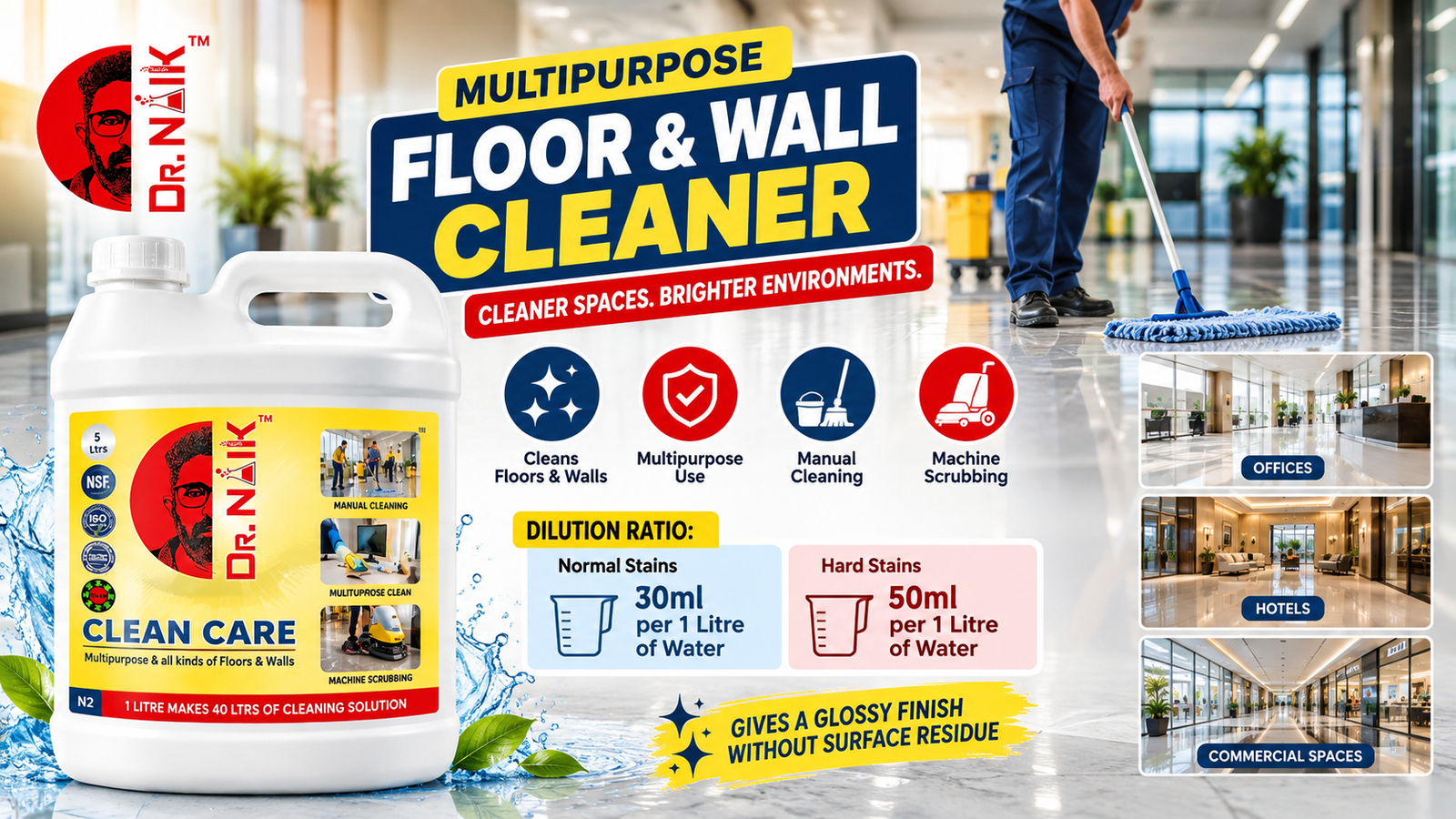
Naik Laboratories’ Dr. Naik Clean Care is labelled as a concentrated multipurpose cleaner for floors, walls and other washable surfaces. Its label indicates that it can be used for manual cleaning and machine scrubbing, with separate dilution guidance for normal and hard stains. This guide explains how businesses can build a practical floor-cleaning routine, choose a commercial floor cleaner responsibly and follow product directions.
1. Match the Commercial Floor Cleaner to the Surface
There is no single cleaning product or method that is automatically suitable for every floor. Commercial spaces may contain ceramic or porcelain tiles, sealed concrete, vinyl, stone, laminate or other finishes. Their care requirements can differ, so identify the floor material and consult the flooring manufacturer’s maintenance guidance before choosing a commercial floor cleaner.
For routine maintenance, consider the kind of soil that typically builds up before selecting a commercial floor cleaner. Dust and light footprints may need a different approach from sticky spills or marks near an entrance. Use a product only on surfaces for which it is intended, and test an inconspicuous area when compatibility is uncertain. This check is essential before adopting any commercial floor cleaner across an entire site.
Dr. Naik Clean Care is labelled for floors, walls and other washable surfaces. That makes its stated intended use relevant to facilities with washable surfaces, but it does not mean every flooring material is automatically compatible. Confirm suitability for the particular surface before use. Surface compatibility should guide every commercial floor cleaner decision.
2. Understand Dilution Before Cleaning
Concentrated products must be diluted according to their label. Using more product than directed does not necessarily improve cleaning and may leave unwanted residue, increase costs or create avoidable handling risks. Using too little may not provide the intended result.
The Dr. Naik Clean Care label gives the following dilution guidance:
Normal stains: 30 ml per 1 litre of water.
Hard stains: 50 ml per 1 litre of water.
Measure the product rather than estimating by eye, and prepare only the amount needed for the task. Follow the complete product label and your facility’s safety procedures. Do not mix cleaning products together unless their labels explicitly confirm that doing so is safe.
The front label also states that 1 litre makes 40 litres of cleaning solution. Because the back label provides dilution instructions for different stain levels, staff should follow the applicable directions on the container for the task rather than treating one dilution as suitable for every situation.
3. Choose the Right Cleaning Method
A commercial floor cleaner may be applied as part of a manual process or used with suitable floor-cleaning equipment, depending on the product label and the machine manufacturer’s instructions. Choose the method according to the area, the surface and the type of soil, and confirm that the commercial floor cleaner is approved for that method.
Manual cleaning can be practical for smaller spaces, edges, corners and areas that equipment cannot easily reach. Staff should use suitable mops or tools and change dirty water when needed, so soil is not simply spread across the floor.
Machine scrubbing can help teams maintain larger open areas. Before using a machine, confirm that the floor and cleaning product are compatible with the equipment. Follow the machine instructions, use the correct solution preparation and keep people away from wet areas until they are safe to access.
Dr. Naik Clean Care’s label specifically identifies manual cleaning and machine scrubbing as intended methods. Facilities should still check the product and equipment directions before use.
4. Build a Cleaning Schedule Around Foot Traffic
A reliable schedule is usually more effective than waiting until floors look visibly dirty. Consider the number of people using the space, outdoor conditions, spill frequency and the activities carried out in each area.
Entrances and reception areas: Inspect frequently because dirt can be tracked in from outside.
Office corridors and shared spaces: Set a regular schedule and respond promptly to spills or visible marks.
Meeting rooms and work areas: Clean according to use, with extra attention after events or heavy foot traffic.
Washable service areas: Follow the relevant surface-care and hygiene procedures for that facility.
A commercial floor cleaner is only one part of the process, so pair product selection with a practical maintenance plan. Pair the product with a schedule that reflects foot traffic and the needs of each area. Assign responsibilities, record completed tasks where appropriate and review the schedule when traffic patterns change. These checks help teams use a commercial floor cleaner as part of a consistent process. Place warning signs around wet floors and restrict access until the surface is safe.
5. Follow a Consistent Step-by-Step Process
A repeatable process helps staff clean thoroughly and reduces the chance of skipped areas.
Inspect the area. Identify spills, visible soil, obstacles and any floor damage that may need attention.
Remove loose dirt. Sweep or dust-mop where appropriate before wet cleaning.
Prepare the solution. Follow the product label and measure the required dilution accurately.
Clean methodically. Work in manageable sections, using a suitable mop or compatible machine.
Manage wet-floor risks. Place warning signs and keep people away from wet surfaces.
Finish according to directions. Rinse if the label or floor-care instructions require it; do not assume every product needs the same finishing step.
Check the result. Look for missed spots, remaining soil or excessive moisture.
Clean and store equipment. Follow workplace procedures for emptying, washing and storing tools.
This process can be adapted to the facility, but the product label and the flooring manufacturer’s guidance should remain the reference points.
6. Control Costs Without Overusing Product
Commercial facilities can use significant quantities of cleaning solution over time. Accurate measuring, staff training and sensible scheduling help make use more consistent and can reduce unnecessary consumption.
To manage a commercial floor cleaner responsibly and get consistent results:
Use a measuring cup or dispenser suitable for the product.
Train staff on the label’s dilution instructions.
Avoid preparing more solution than the task requires.
Store the container as directed and keep its label legible.
Review consumption and cleaning outcomes together rather than judging performance by how much product is used.
For Dr. Naik Clean Care, the label’s guidance is 30 ml per litre of water for normal stains and 50 ml per litre for hard stains. Staff should use the direction that matches the task and should not increase the concentration beyond the label instructions.
7. Put Safety and Surface Care First
Commercial cleaning often takes place while people are working or moving through a facility. Plan tasks to reduce disruption and prevent slips. Safe handling is as important as selecting an appropriate commercial floor cleaner. Use wet-floor signs, keep walkways clear and follow the site’s procedures for personal protective equipment and chemical handling.
Read the full label before use. The Dr. Naik Clean Care label warns against using the product in concentrated form, advises keeping it away from children and warns against eye contact. It also instructs users to rinse thoroughly with water in the event of eye contact. Follow all label precautions, and consult the manufacturer or a qualified professional if a safety or compatibility question is not answered by the label.
Never mix products unless the labels explicitly permit it. Keep cleaning chemicals in their original, labelled containers and store them securely. Staff should know how to respond to spills and where to find the facility’s relevant safety instructions.
How Dr. Naik Clean Care Fits into Commercial Floor Maintenance
Dr. Naik Clean Care is a multipurpose cleaning product from Naik Laboratories. Its label describes it as a concentrated solution for floors, walls and other washable surfaces, and identifies both manual cleaning and machine scrubbing as uses. It also describes a fragrance and a glossy finish without surface residue.
For facility teams considering a commercial floor cleaner, the most useful starting point is to match the product’s labelled uses and dilution instructions to the actual cleaning task. Confirm that the intended surface is compatible, prepare the solution as directed, and choose a manual or machine method appropriate to the space.
The product label lists 30 ml per litre of water for normal stains and 50 ml per litre for hard stains. These directions should be followed as written when using a commercial floor cleaner; they should not be treated as a guarantee of identical results on every surface or type of soil. Always check the label before use.
Conclusion
An effective commercial floor-care routine combines the right product, correct dilution, a suitable cleaning method, a realistic schedule and clear safety practices. Businesses should assess their floor materials and daily cleaning demands before choosing a commercial floor cleaner, then train staff to follow product and equipment instructions consistently.
Dr. Naik Clean Care is labelled for floors, walls and other washable surfaces, with directions for manual cleaning and machine scrubbing. By following its label, confirming surface compatibility and maintaining a consistent process, facility teams can make floor cleaning more organised and repeatable.