
Product Manufacturing Process: From Formulation to Final Packaging in 7 Essential Steps
Introduction
The Product Manufacturing Process plays a crucial role in delivering safe, effective, and high-quality personal care products to consumers. Whether it is shampoo, body wash, hand wash, skincare cream, or household cleaning solutions, every product undergoes a carefully planned manufacturing journey before reaching store shelves.
The complete process of manufacturing personal care products involves scientific research, ingredient selection, formulation development, production, product filling, packaging, and strict quality testing. Every stage is designed to ensure consistency, safety, and compliance with industry regulations.
Modern manufacturers rely on advanced technology, automated production lines, and rigorous quality standards to produce reliable products that meet customer expectations. Understanding the Product Manufacturing Process helps businesses appreciate the importance of precision, innovation, and quality manufacturing in today’s competitive market.
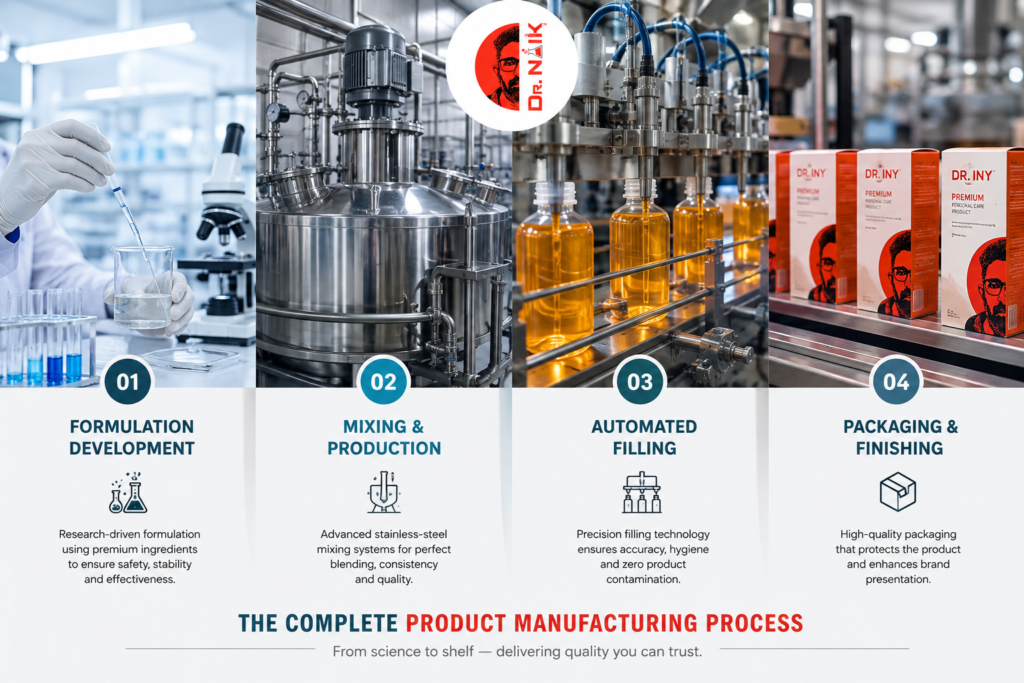
1. Product Concept and Research
Every successful Product Manufacturing Process begins with a clear product idea. Manufacturers first identify market demand, customer preferences, and product performance requirements.
During this stage, experts evaluate:
- Consumer needs
- Industry trends
- Ingredient compatibility
- Regulatory requirements
- Product positioning
Research helps determine whether the product should focus on moisturizing, antibacterial protection, fragrance, natural ingredients, or specialized performance.
A strong foundation at this stage reduces development time while improving overall product success.
2. Formulation Development
One of the most important stages of the Product Manufacturing Process is formulation development.
Scientists and chemists carefully combine raw materials to create a stable, effective, and safe product. Every ingredient serves a specific purpose, such as cleansing, moisturizing, preserving, thickening, coloring, or enhancing fragrance.
The formulation is repeatedly tested to achieve:
- Desired texture
- Proper viscosity
- Balanced pH
- Long shelf life
- Stable fragrance
- Excellent product performance
Multiple laboratory trials ensure the final formulation consistently delivers the expected results.
3. Raw Material Selection and Quality Inspection
Raw materials directly influence the quality of the finished product. Reliable manufacturers only source ingredients from approved suppliers.
Before production begins, every raw material undergoes inspection for:
- Purity
- Safety
- Batch consistency
- Moisture content
- Chemical composition
- Compliance with quality standards
This quality-focused approach strengthens the overall Product Manufacturing Process while minimizing production risks.
Using premium ingredients also improves customer satisfaction and product reliability.
4. Production and Mixing
Once ingredients are approved, manufacturing begins using specialized mixing equipment and automated processing systems.
Large stainless-steel vessels blend ingredients under carefully controlled conditions.
During production, manufacturers monitor:
- Mixing speed
- Temperature
- Pressure
- Processing time
- Ingredient sequence
- Batch consistency
Automation minimizes human error and ensures every production batch maintains identical quality.
This stage is the heart of the Product Manufacturing Process, where carefully developed formulations become finished products.
5. Quality Manufacturing and Testing
No product moves forward without comprehensive quality manufacturing procedures.
Modern laboratories conduct extensive testing throughout production to verify product safety and performance.
Common quality tests include:
- Microbiological testing
- pH analysis
- Stability testing
- Viscosity testing
- Appearance inspection
- Fragrance consistency
- Performance evaluation
Manufacturers also maintain detailed production records for complete traceability.
Continuous testing ensures every batch satisfies both regulatory requirements and customer expectations.
6. Product Filling and Packaging Process
After approval, products move to automated product filling lines.
Modern filling machines accurately dispense products into bottles, jars, tubes, or pouches while maintaining hygiene and minimizing waste.
Following filling, products enter the packaging process, where they receive:
- Caps
- Pumps
- Labels
- Safety seals
- Batch numbers
- Manufacturing dates
- Cartons
- Shipping boxes
Advanced packaging systems improve production efficiency while protecting products during transportation and storage.
An efficient packaging process also enhances product presentation and strengthens brand identity.
7. Final Inspection and Distribution
The final stage of the Product Manufacturing Process focuses on product verification before shipment.
Quality teams inspect finished products for:
- Correct labeling
- Leak testing
- Packaging integrity
- Batch accuracy
- Product appearance
- Carton quality
Only products that meet all quality standards are approved for distribution.
Efficient warehouse management and logistics ensure products reach retailers, distributors, and customers in perfect condition.
Why Modern Manufacturing Matters
Today’s consumers expect products that are safe, consistent, and environmentally responsible.
Modern manufacturing facilities invest heavily in:
- Automated equipment
- Digital monitoring systems
- Sustainable production practices
- Energy-efficient machinery
- Hygienic production environments
- Quality management systems
These investments improve production efficiency while reducing waste and maintaining high manufacturing standards.
Businesses that prioritize innovation gain greater customer trust and stronger market competitiveness.
Benefits of a Well-Managed Product Manufacturing Process
A structured Product Manufacturing Process provides several advantages:
- Consistent product quality
- Improved production efficiency
- Reduced manufacturing errors
- Better regulatory compliance
- Faster production cycles
- Enhanced customer satisfaction
- Lower operational costs
- Increased product reliability
- Stronger brand reputation
- Greater scalability for future growth
These benefits allow manufacturers to maintain long-term success while meeting changing consumer expectations.
Choosing the Right Manufacturing Partner
Businesses seeking private-label or contract manufacturing should evaluate their manufacturing partner carefully.
Important considerations include:
- Industry experience
- Research and development capabilities
- Certified production facilities
- Advanced equipment
- Quality control systems
- Flexible production capacity
- Regulatory compliance
- Reliable packaging solutions
An experienced manufacturer supports businesses throughout the complete process of manufacturing personal care products, ensuring consistent quality from concept to delivery.
Conclusion
The Product Manufacturing Process is far more than simply mixing ingredients and filling bottles. It is a carefully controlled journey that combines scientific research, formulation development, premium raw materials, advanced production technology, quality manufacturing, precise product filling, and an efficient packaging process.
Every stage contributes to creating safe, effective, and reliable personal care products that consumers can trust. As manufacturing technologies continue to evolve, businesses that invest in innovation, automation, and quality assurance will remain competitive in an increasingly demanding market.
Understanding the Product Manufacturing Process helps brands appreciate the value of precision, consistency, and continuous improvement, ensuring every finished product meets the highest standards of quality while delivering exceptional customer satisfaction.